
Betty Church
How keeping one small practice gathered a congregation we never planned.

On a Sunday morning at Cherry Beans, in Westfield, there’s a bowl of hot chips with aioli on the table, herby fries they call them, sprinkled with sea salt and rosemary, and there’s Betty, working the room like a mayor. Half the cafe drifts past our table to say hello to her, and to us. Phiona is laughing at something Betty said, loose and playful in a way I almost never saw in our first years in this country. Serena is in her own seat now, a promotion from the high chair she straddled when we first came here. Delvin, over ten now, has been gently retired from the little playground in front of Big W that he used to bolt for the moment we arrived, an exile he bears with dignity. This is the warmest hour of our week, and I have come to believe it is also a holy one.
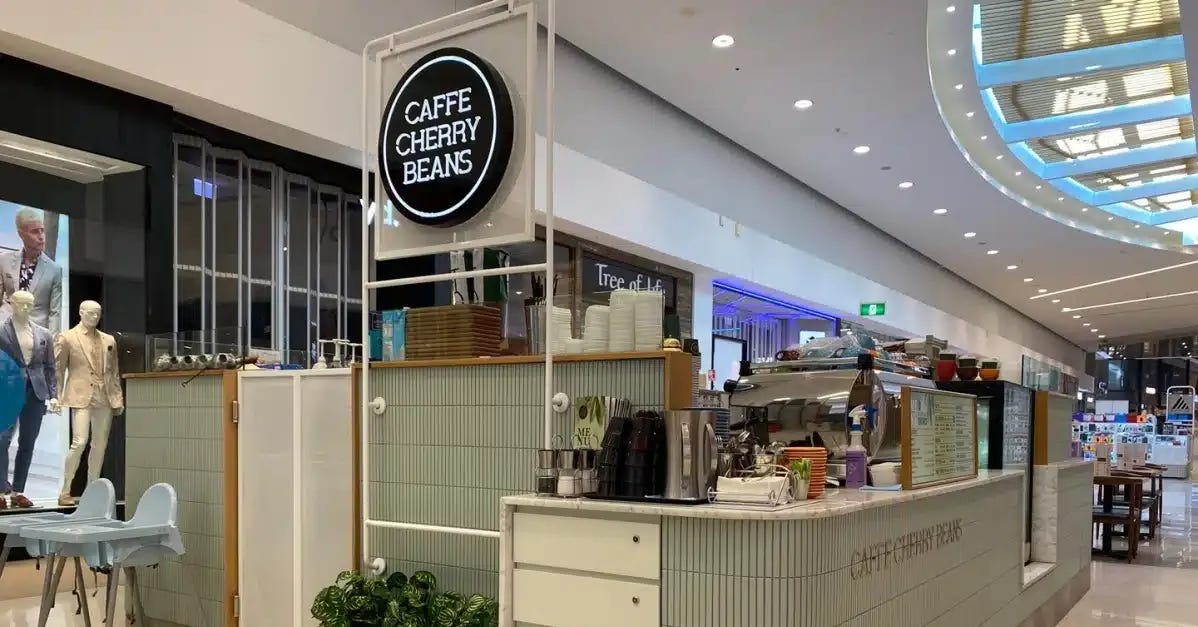
For years I’d hustle the children out of that cafe to get to church on time, because I was raised that Sundays mean church and you must always go. Then, one Sunday Betty teased me about it. Why leave this to go and do that? I laughed it off. But the question stayed, and over the next few weeks I started doing the maths.
At church, we arrived at the same time each week and found our seats. At Cherry Beans, we arrived at the same time each week and found our table. At church, a band played, and we sang along to the words on the screen. At the cafe there was no band, but the mall piped music down through the ceiling, so even that was covered. At church, a pastor got up and preached a sermon, prepared across the week and built around a theme, meant to make you look hard at your own life. At our table no one prepared anything, but someone always said a true thing about their week, not from a stage but across the chips, until we all went quiet with it. At church the bread and the cup were passed along the row. At the cafe a bowl of hot chips sat in the middle of the table, and we all munched from it. And after church came the part people really stayed for: the coffee, the catching up, the person who clocked that you weren’t there last week. At the cafe, that part was the whole service.
The more I lined them up, the harder they were to tell apart. Same gathering, same music, same hard mirror held up to your week, same shared food, same people who’d miss you. One has a stage and a building. The other has Betty and a booth. I’m not saying they’re identical, and I’d never wave off what the bread and the cup mean to the people who hold them sacred. But Betty had been right to tease me. I’d been leaving church to go to church.
So I gave Betty the job. Betty Church, I told her, and you’re the pastor. She laughed and said, “When you put it like that, I think it’s true.”
It did not start as anything, and it did not start with me. Phiona started it, back when we lived in Chermside, a breakfast out on the weekend, no fixed spot, just a way to be a family out in the world. All these years later, it is the oldest ritual our family keeps. After COVID, with her working night shifts and one car between us, we needed a way to synchronise and catch up for the week, somewhere to come back to, to centre. So the search got serious. We landed at Cherry Beans for a reason that tells you everything about my wife. They made her hot chocolate with what tasted like real milk. She is a Mubito, of the Babito clan, the royal line of the Tooro Kingdom, a cattle-keeping people for whom milk is sacred. I am a Muhenda, of the Bahenda clan. Mine were hunter-gatherers, and we work with what we get. So we kept going back for the milk.
There was an older couple always there on a Sunday, in the booth beside ours. First we nodded good mornings at each other. Then, because the booth had a small table and a larger one, we started pulling our tables together. They liked the children. Numbers were exchanged, then texts when one of us was away. Nobody founded a thing. We just kept showing up, and the showing up became a norm we looked forward to.
It got tested, too. Jason and Jenny, who owned the place then, had to shut the cafe on Sundays for six months, too expensive to run, no staff to be found. We wandered North Lakes like a small displaced parish, comparing everyone else’s chips to home. Degani wouldn’t serve chips before eleven. Moderne didn’t have them at all. Coffee Club had them, but they weren’t the herby fries. We were ruined for anywhere else. The Sunday Cherry Beans reopened; we came back as though nothing had happened. So did everyone else.
Later Jason and Jenny sold up to Stella and Ronnie, and Betty helped the new owners keep what we were used to. These days Stella and Ronnie test their new dishes on us first. We didn’t build the thing so much as it built itself around our showing up, and it turned out not to depend on who owned the espresso machine. The story was portable. It outlived its cast, which I am told is what stories are for.
It has been years now. We have marked birthdays at that table, Mother’s Days, anniversaries. And there have been the other kinds of weeks, hospital trips and back, stretches away travelling and back. Whatever the week held, we return to that Sunday morning, and it holds us. A fixed point a whole life can turn around.
The part that moves me most is what it has done for Phiona. I once carried her across the world from a place where she knew everyone to a city where she knew no one, and I have carried the guilt of that for a long time. At Cherry Beans, I have watched her come out of her shell and settle into a collective, teasing Betty, joking with Stella, easy among people in a way that used to be hard for her here. The woman who knew somebody every a hundred metres in Kampala has a corner of North Lakes where she is known again. I didn’t give her that. We only kept the practice, and the practice gave it to her. It took me years to see what the practice itself had been all along. The weekend habit she started back then was her building back the thing she’d lost, one breakfast at a time. Without meaning to, without a plan or a single meeting, she had storified a cafe into a church. I just kept showing up to it until I noticed.
What I’d tell the lonely
I know how this sounds in an age of loneliness studies and community apps. Everyone is trying to find community, and the word find is the problem. We didn’t find one, and we certainly didn’t build one. We kept one practice, faithfully, in one place, and a community grew around it the way reef grows on something that stays put.
If we had set out to build it, I think we’d have failed. Imagine the meeting. We are seeking six to ten warm acquaintances for weekly fellowship. Nothing assembles under those conditions. The older couple did not join a program. They sat near a family that was reliably there, and reliability, it turns out, is the whole liturgy. You do not found a congregation. You keep showing up consistently where people gather, and one slowly forms around you.
And you do not build the sacred, either. You recognise it only after it is already there. Nobody at that table ever decided it was holy. Run the inventory anyway. A fixed morning, kept against all convenience. Food shared. The same faces, missed when absent and welcomed when returned. The week’s news told and held. Counsel passing across a table from people decades ahead of us on the road. People who would notice if we vanished, and we know they’d notice, because the one six-month stretch when the doors shut, everybody mourned and everybody came back. Whatever church is for, that table does it.
The thing never needed our commentary to work. It needed our showing up. We still call it Betty Church, and I mean it more than I can quite explain. We return to it through everything, and it holds us together. If that’s not sacred, I don’t know what is.
Questions to carry
What’s the smallest practice you could keep so faithfully that something might grow on it? Not start, keep.
Who has been authoring your belonging without credit, the way Phiona authored ours? Have you ever told them what they built?
Is there something ordinary in your week that has quietly become sacred? Would you recognise it if it had?
 | A guest post by
|