

Abstract
This paper proposes that meaning is co-constituted, neither produced by individuals alone nor poured into them from above, and that the practical work of sustaining it belongs to a role here named the storifier, the author of a collective’s story. The modern problem it addresses is isolation: individuals cut off from the larger sources from which meaning grows. Drawing on the layered stewardship architecture of ERE I: The Embodied Steward, it identifies authoring as the continuous practice through which collectives at every scale, from the cellular to the trans-generational, remain connected to those sources and remain intelligible over time. The recovery move is to reconnect by taking up the storifier’s work within the collectives one already inhabits. The paper is the technical companion to a forthcoming essay series that takes up the same material from within particular scenes. A glossary appears at the end.
A note on this paper
This is the second paper in a triad that began with ERE I: The Embodied Steward, which named the layered architecture of stewardship across the cellular, interior, interpersonal, familial, and cultural scales, and continues with ERE III: The Inner Architecture of Participation, which develops the inner architecture of the participating self (Person, Ego, Agent). Each can be read on its own. The argument sits near virtue ethics in the MacIntyre line and the meaning-crisis literature of Vervaeke and Taylor. It draws on enactive cognition in the Varela and Thompson line, on object-relations work in Winnicott and Stern, and on Porges’ polyvagal account of social engagement. It is best read as a phenomenological and participatory proposal, an account of how meaning works from inside the living of it, rather than as an empirical study, and it is supported where cognitive science, philosophy, and developmental psychology independently arrive at the same point. The framework has been developed and tested through stewarding a body, an interior, a household, a family, and a small community over the better part of a decade. The first-person voice has been kept out, so the framework can stand on its structural merits; the autobiographical material is reserved for the companion essay series. Readers who prefer scenes to structures may want to begin there and return here for the architecture.
1. The Individual-Meaning Trap
There is a particular moment that recurs, unannounced, in lives that, from across the street, look like they are working. The bills are paid. The job is reasonable. The relationships are mostly fine. The weekends arrive. And still, sometimes after the third glass of wine, or in the long flat stretch of a Tuesday evening, or in the silence after the children have gone to bed, the question lands without warning: “Is this it?” Readers who have had the moment will recognise it. Others are welcome to read on. The moment arrives in a register subtler than complaint and quieter than clinical depression. It is closer to a low hum that turns up the volume on everything that should be enough and quietly registers that it isn’t.
That moment has a structure. It is the predictable signature of having been handed a particular instruction set for how to make a life, and of having followed it. Distilled to its operating premise, the instruction runs like this: meaning is a private production, selfhood is something to be authored alone, and the proper task of an adult is to discover or construct values that are uniquely one’s own. It has done real good. It freed earlier generations from conformities that modern life has rightly stopped tolerating, and it gave permission to set down ill-fitting inheritances, to question received form, and to assemble identities from the inside outward. Those gains are real, and they are kept.
The trouble is narrower and harder to see because it is so widely shared. Beneath the gains ran a second premise: that once the older structures were cleared away, meaning could be produced by individuals working alone. That premise has come up empty. An individual can draw on meaning, inflect it, carry it, and pass it on; what an individual cannot do is be its source. No man is an island, John Donne wrote, and the modern hum is the sound of people trying to be one. The body is reporting a fault in the architecture, and the self itself is sound.
The shape of the failure has been described in two registers, and the descriptions converge. In sociology and public health, the picture is now familiar: declining membership in shared institutions (Putnam, 2000), the chronic health costs of social isolation (Holt-Lunstad et al., 2015), and the generational rise in anxiety and depression in industrialised societies (Twenge, 2017; OECD, 2023). The data is the dry version of what the hum already knows. The plainer translation: a person can be surrounded by company and still have no one to call when it counts, because those nearby offer proximity without participation and remain, in the way that matters, strangers. The look of belonging is everywhere; the feel of it has thinned. Modern culture has been running individual-meaning software on bodies built for collective participation, and the system keeps crashing for the same reason.
The materials of meaning all arrive from outside the person and from before them: language, narrative, symbol, ritual, and the very sense that a life is intelligible to anyone at all. They come from sources larger and older than any single person, deep enough that no one life could exhaust them. Participation keeps them alive, and they thin when held alone. To expect to generate meaning from first principles, inside one’s own head, is a category error, on a par with growing one’s own food on a kitchen counter without noticing that the seeds, the soil, the water, and the sun all belong to a larger system one did not invent.
A vicious circle sits at the heart of the modern arrangement. Trust in shared meaning is at a historic low, leaving people without the substrate, the soil, from which collective meaning could grow. That, in turn, lowers trust further, prompting people to conclude they had better try on their own. Do-it-yourself meaning comes to feel like the only option, and it is a poor one. The system fails for structural reasons rather than for lack of dedication, and the failure compounds the more the architecture is relied upon. Each person tries harder, in isolation, to solve a problem that has never been solvable in isolation.
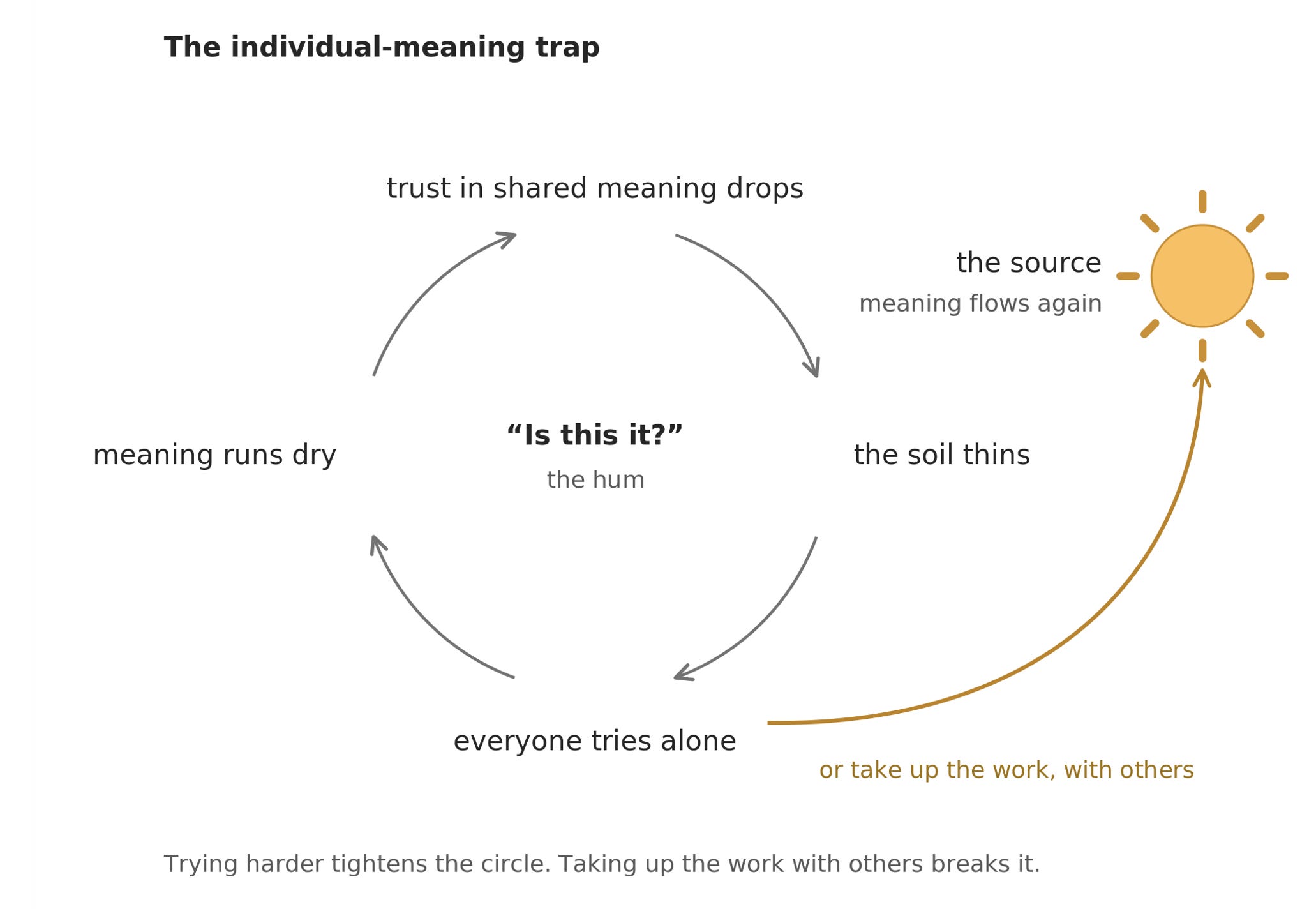
The diagnosis sits within a wider conversation now called the meaning crisis, mapped from several angles: by John Vervaeke and Charles Taylor, and by James K. A. Smith and Byung-Chul Han. Two things make this framing distinctive. It traces the failure to one missing element, a living connection to the sources from which values and beliefs grow; people in the trap usually hold plenty of values and beliefs. And it names a stance that reopens that connection, available within whichever collectives a person already inhabits.
The person who feels the hum and the person who can answer it are the same, at two moments in one life. The way back from isolation runs through that person taking up, for themselves, the work of making and maintaining shared meaning; and the moment they do, the larger source reopens, and meaning that could never be manufactured begins to flow. What that work is, what it draws on, and what stance it asks of the one who takes it up are the questions the rest of this paper addresses.
This argument belongs to the larger architecture of Embodied Resonant Emergence (ERE), set out in The Embodied Steward. Where ERE I named the architecture, ERE II names the role. Naming this role challenges the idea that meaning can be made in isolation.
2. What Meaning Is Made Of
The picture of an individual self assembling meaning from within its own consciousness has the feel of obvious truth, which is part of why it survives. The thinking happens behind the eyes. The deciding happens in a particular head. The grief, the elation, the slow-forming preferences all happen inside what feels like a private space. The position feels too real to be wrong.
It only looks that way until the contents of that private space are examined. Consider what the apparently individual self is made of. The language it thinks in, which it neither invented nor could. The narratives it uses to make experience intelligible, nearly all inherited from collectives: family, culture, religion, peer group, the wider language community, and social media. The inconclusive arguments it keeps running at three in the morning, long after the conversation itself is over. The arbitrary cultural and traditional defaults that determine which experiences it treats as important. The lineage carried in the body: the postures, the food preferences, the implicit metaphors. None of this is private. All of it is collective material taken in and personalised.
The interior of a self, then, is itself a small collective, characterised as a “village of me’s,” stewarded by a “Master Me.” This framing overlaps with dialogical self theory (Hermans, 2001), Internal Family Systems (Schwartz, 1995), object-relations work, and enactive cognition; it is heuristic rather than metaphysical, and ERE III develops it. The point easiest to miss is that even the most private moments of a life, such as sitting alone, thinking, deciding, grieving, occur within a collective, one whose membership is interior rather than visible.
Most contemporary writing on collective meaning treats it as something to add to an individual life, a supplement meant to make an isolated existence more meaningful. The proposition runs: more community, more connection, more shared tradition, laid over selves that are otherwise doing fine on their own. The picture is mistaken. Individual meaning is real, but its potency depends on a larger source, without which it dwindles to almost nothing. The dependence runs both ways, since a collective’s meaning is only ever as alive as the people taking part in it, and the fewer they are, the more it fades. A Mexican wave is a good example: no single person can make one on their own, and yet when enough rise together in time, something unmistakably real runs around the stadium.
The source can be even larger: older than any life and, like the sun, inexhaustible enough to keep a whole world of meaning lit. A person who turns towards a source like that grows like living things towards light, into a life that holds more than they could have generated on their own.
This is not a new claim, only one steadily un-thought across the last century. Wittgenstein and Heidegger reached it by different routes. Wittgenstein’s private-language argument shows that the conditions for linguistic meaning are necessarily public: a language only one person could understand would not be a language. Heidegger’s being-in-the-world shows that the conditions for existential meaning are participatory: the self wakes already within a world disclosed by others. John Vervaeke has restated the point for contemporary practice, naming the opposite assumption propositional tyranny, the idea that knowledge is a stock of propositions owned by the individual who holds them. Three routes, one observation: a person is first inside meaning before they can experience or make it.
Connecting to such a source rarely happens through belief. It is closer to the way a driver stops noticing the car and feels the road through it, or to the way clothes become part of the body’s sense of its own edges. Polanyi (1966) called this indwelling: we attend from the forms we have taken in, not to them. Joining a living tradition works the same way. A person does not first judge it true and then enter; they take part until its shapes are inhabited and begin to resonate, and meaning arrives through that resonance. This is what the framework means by resonant and embodied: the connection is lived before it is believed.
Collective meaning encompasses more than one thing, and this paper focuses on a particular one: existential meaning, the sense that a life matters. The case for treating it as collective is strong. Baumeister and Leary (1995) showed belonging to be a fundamental human motivation, and the seventy-five-year Harvard study (Vaillant, 2012) found that the strength of close relationships predicts a meaningful life more reliably than any other measured variable. Existential meaning requires ongoing participation in collectives that treat one’s presence as relevant. The word carries other senses too, including what words mean, how experience becomes a story, and the felt sense of being at home. These are real and related, though not the through-line here.
No reader is exempt from this. Live with a partner and three children, and you are making collective meaning within a household; live on your own, and you are still making it, with the village of me’s, with absent others, and with the cultural materials you carry. Individuality is one configuration of the collective, a particular shape it takes. Mead (1934) and Vygotsky (1978) argued as much from social and developmental psychology: the self emerges from social process, and the inner life is the internalisation of relations already had with others. The materials differ. The work does not.
Some of the most lucid moments people report, such as solitary contemplation, wilderness, aesthetic absorption, certain kinds of craft, and the mystic’s inward knowing, appear non-participatory in any obvious social sense. The framework grants them. Its claim is only that even solitary meaning rests on materials, a language, a tradition of attention, an inherited form, and a community of practice, all of which are collective in their genealogy. Solitude is real, and sometimes the medium in which meaning is most clearly disclosed. What is collective is the substrate, not always the moment.
One concern is fair to raise: the approach seems to assume that a person is already at a certain point in life, ready to admit that meaning made on one’s own cannot complete a life. People reach that recognition by different routes, from Frankl (1946), who shows how survival itself can depend on a meaning located beyond the self, to Taylor (1989; 2007), who shows how modern selfhood lost the participatory horizons older traditions assumed. Without that recognition, the practices that follow feel arbitrary; with it, they reveal their structure. Part of what this paper offers is the recognition itself, as a frame a reader can step into.
3. The Storifier
Every collective the reader has been part of for any length of time has, somewhere inside it, a person doing a particular kind of work that has no job title and that nobody quite knows how to thank them for. They are the one who, around the third year of a marriage, notices that the way the couple makes coffee together on Saturday mornings has started to mean something, and quietly keeps the practice going. They are the one in the team who, after a difficult week, sends the message nobody else thought to send. They are the one in the friendship circle who first uses an inside joke and then uses it again and again until it becomes the group’s shorthand. They are the one in the family who remembers what last Christmas was like and, without writing anything down, carries that memory into this one, so that what Christmas means in this family accretes year over year rather than disintegrating.
These people are often quiet, outside formal leadership, and unaware they are doing anything in particular. What they are doing, in a precise sense, is authoring the collective’s story. The work has structure, even when the person doing it has no language for it. Most readers can name at least one such person in their own life. Many will recognise that they have been that person in at least one collective they belong to. Until this moment, the work has been going on without a name.
This paper calls that person the “storifier,” or, in a weightier register, the author of the collective’s story. The first name captures the hands-on, in-the-moment nature of the work; the second captures what is at stake. What the storifier tends is the collective’s living connection to the sources from which its meaning grows.
Meaning is a flow, not a deposit, so a collective has to keep making it or watch it thin. It is sustained by ongoing participation, attention, and the repeated, usually invisible decision to keep treating the collective as real and worth the trouble. Berger and Luckmann (1966) described the cycle in The Social Construction of Reality: shared worlds are externalised in practice, treated as objective, and re-internalised by newcomers. A family invents Friday movies; Friday movies become “what we do”; the youngest child grows up inside them as if they were weather. The cycle has to run continuously, or the world fades. The storifier is whoever does more than their share of that work, keeping the collective’s channel to its sources open while everyone else lives off it.
Underneath the work lies one cognitive move worth naming, because once it is named, the work looks different. In Vervaeke’s terms, the storifier manages relevance realization for the group: what gets foregrounded and what recedes, what is invoked and when, what is left unsaid, which story gets retold at dinner and which is allowed to rest. Scaled from the individual to the collective, that management is the storifier’s central task, keeping the group’s attention turned towards what gives it life. That is why the work is felt before it is argued. A storifier rarely tells people what to think or teaches them what to do; they hold the stance from which the collective sees its world, and the shared enactment that keeps that world alive. Instruction and doctrine ride on top of that, and without it they remain inert.
Three features of the role are easy to misinterpret, and getting them right is part of what keeps it honest.
The role is a function, not a rank. In a family, the storifiers are usually the parents, though only because the children are still too contained within the story to author much of their own; as they grow, they take on portions of the work, often unnoticed. In a team, it is the lead, the senior contributor, or the operations person who quietly schedules the rituals everyone assumes were always there. In a friendship, it is whoever holds the group chat and remembers the birthdays.
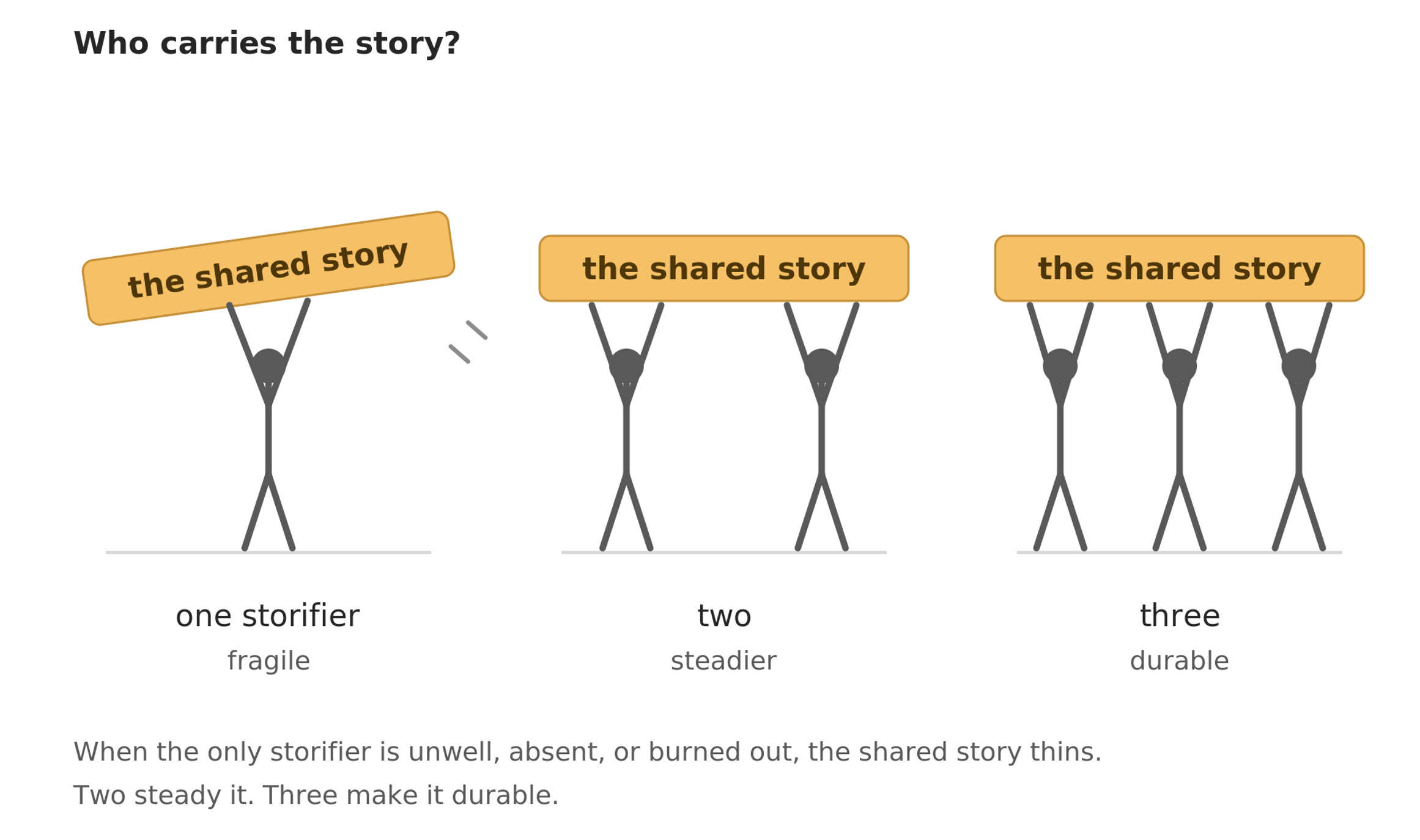
The role is distributed. Healthy collectives have more than one storifier. A family where only one parent does the work is fragile in a precise way: when that parent is unwell, absent, or burned out, the shared story thins. Two storifiers steady it; three make it durable. Distribution is a requirement for anything meant to last, not a luxury.
The role is performed from within the story. That is what separates it from the editing and directing that management books recommend, and the closest disciplined treatment lies in the theatre rather than in management. Keith Johnstone’s Impro (1979) and Viola Spolin’s Improvisation for the Theater (1963) describe a craft in which the performer holds the arc of a scene while being a character within it, accepting what other players offer and building on it. Goffman (1959) made the same sociological observation: ordinary life is something we perform while the situation performs us. The storifier does this in everyday life, improvising the scene with everyone else while holding a sense of its arc that nobody asked them to carry and that they cannot put down. It is hard for the reason improvisers know: you cannot step out of the story to fix it. You keep authoring while being authored, your own part shaped by the collective you are shaping.
It explains why so much advice about family or team culture fails to land: the advice is often sound, but it assumes you can step out of the play to rewrite the script, which you cannot. The work is done within the same scene, with the same materials, in real time. It is also why, when done well, it stays mostly in the background.
The role usually begins as instinct: someone feels the vibe of a room and adjusts, or is triggered by a memory of something similar. With time and attention, the instinct becomes a discipline that works alongside it, and that discipline can be learned. The practices inventoried in Section 4 are its apprenticeship. Recognition itself is already part of the equipment; once the work has a name, a person can take it up more deliberately within the collectives they already inhabit. This is the move out of isolation that Section 1 pointed to: taking up for oneself the tending of the connection through which meaning comes. None of this is control. The storifier is not deciding what others should think; they are keeping open the conditions under which a shared world stays shared and connected to its sources, beginning with the nearest one: the life they are already living. But the same position can be turned to harm, and an honest account looks at that next.
3.1 Participation Is Not Always Restorative
Everything said so far could be read as a brief for community, as though more participation were always the cure. It is not. Anyone who has lived in a family that suppressed reality, or in a friendship that made loyalty conditional on silence, knows that a collective can fragment a person as surely as it can hold one. Much of the deepest suffering takes the form not of too little participation but of too much: wholehearted, sustained participation in something that is doing harm. Not every collective connects its members to a living source; some are closed loops that feed on them instead. Participation is constitutive, selves are made of it, and it was never promised to be benign. The medicine and the poison run through the same vein.
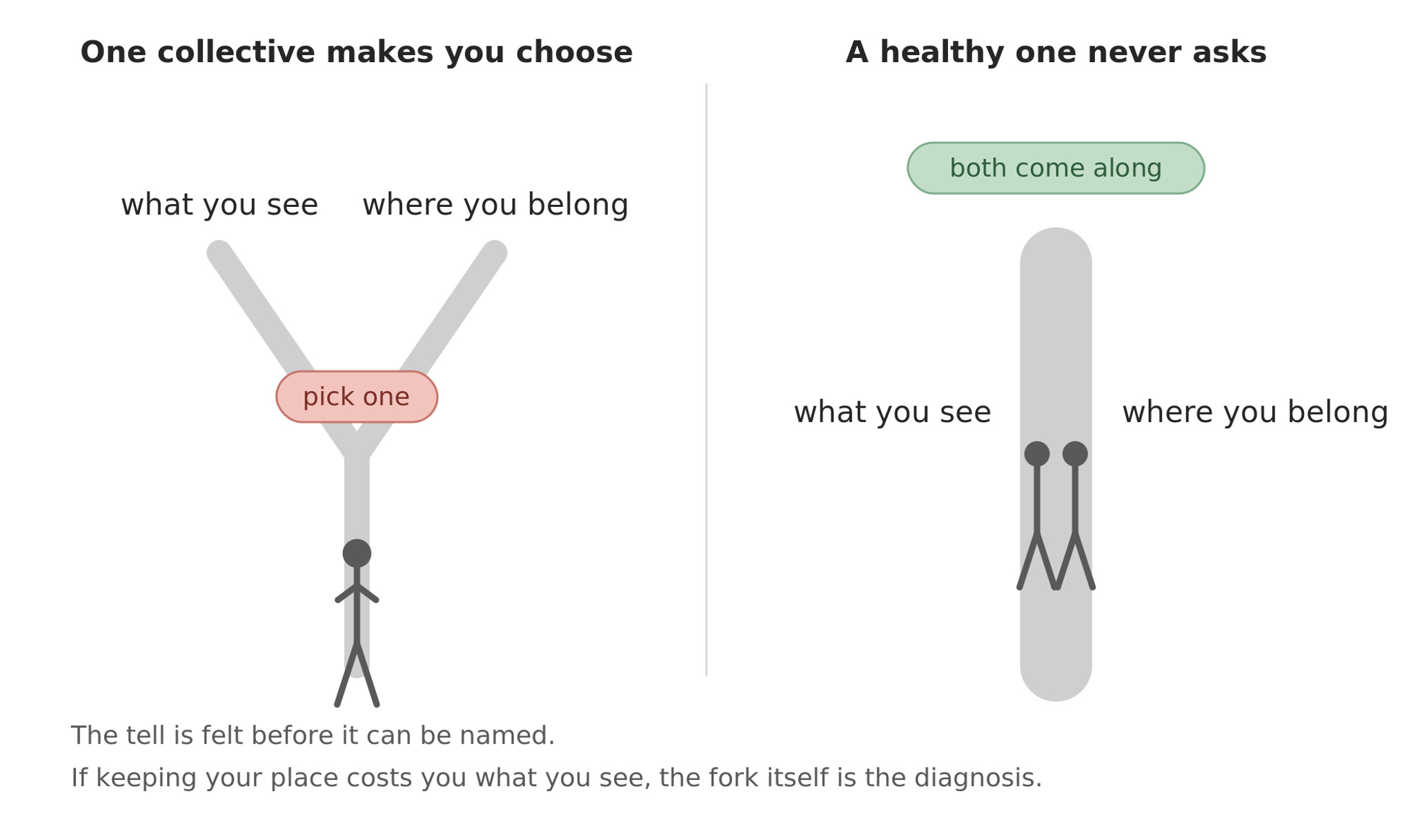
If the two run through the same vein, the practical question is how to tell them apart. The markers of pathological storification align with what Robert Lifton (1961) called the signatures of totalism: milieu control, the demand for purity, and the doctrine held above the person. Within a collective, they take a recognisable shape. There is narrative monopolisation, in which the storifier becomes the only voice permitted to define the collective. Dependency-production sets in when members lose the capacity to author for themselves, so the arrangement works only while the storifier is present. Symbolic foreclosure renders certain experiences unsayable, enforced by ritual or by the borrowed authority of the past: the family in which the year the business failed may never be mentioned. Reality-suppression hardens a group’s mythology against the evidence, so that whoever notices the gap is made to feel they are the problem. And inherited shame, the oldest pattern, carries forward the self-erasure an earlier generation suffered and dresses it as fidelity. Beneath all five runs a single tell, one a member feels before they can name it: the sense that they must choose between their own perception and their belonging. Healthy collectives ask for no such choice. The presence of the choice is itself the diagnosis.
Seen this clearly, the failure tells us two things. The first is absorbed elsewhere in the framework, under the name “storifier malpractice.” The other is harder and matters more: exit can itself be the correct authoring move. A storifier who participates skilfully within a corrupt collective is not doing good work; they are keeping the corruption well told. When a collective tips towards dependency and will not be corrected, the most faithful authoring that remains is to leave, and to find a source that gives life rather than draws it.
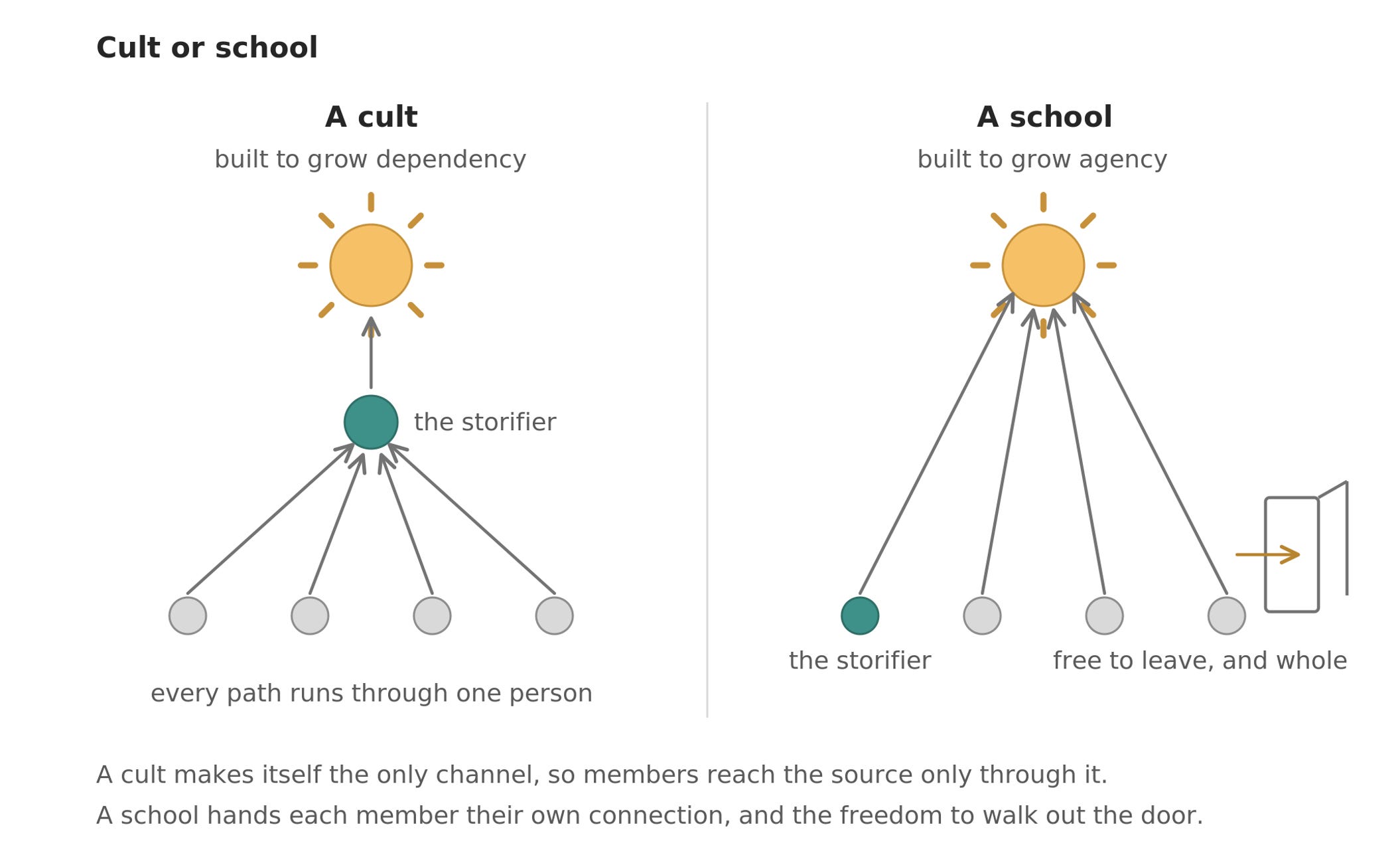
Naming exit as a move forces the harder question. Does a single figure who shapes a collective’s story not amount to soft authoritarianism, a charismatic centre that everyone else orbits? The role described here is its opposite. John Vervaeke draws a line worth borrowing: a cult is built to increase its members’ dependency, a school to increase their agency, including the agency to walk out the door. The same line runs through the storifier’s work. A cult-shaped storifier makes themselves the only channel to meaning, so members can reach the source only through them; a school-shaped one does the reverse, handing members their own connection to it, so they can author for themselves, leave the collective and remain whole, and go on to author collectives of their own. A storifier who must be the only narrator, who takes their identity from being indispensable, is doing that first job, and this paper does not endorse it. The three features named earlier are the structural guard against drift.
Step back from the failures and ask what the storifier keeps alive when the work goes well. Across almost every culture, the answer is a story. A story is a structured account of someone’s transformation in a dynamic situation, which also fairly describes sustained participation once it is put into words. The claim has to be made carefully: not that a life is a single narrative in the strong sense Galen Strawson (2004) rightly disputed, since some lives are lived more episodically than narratively, but that story is one of the dominant forms through which the underlying participatory structure becomes sayable and transmissible. MacIntyre (1981) called it the narrative unity of a human life; Ricoeur (1984–1988) built narrative identity across three volumes; Bruner (1990) showed that narrative is one of the mind’s basic modes. The storifier’s work is to keep that story, and the participatory forms gathered around it, alive and connected to its sources.
Every narrative tradition produces two figures, and both stand within this one. The hero learns to read a transforming situation and to respond to it, and the transformation usually costs the old self something. The sage has gathered enough harmonious moments of participation to guide others through their own transformations. The storifier, in any collective that lasts, is a configuration of the sage: the one who keeps the arc legible and the source open, while everyone, the storifier included, is still inside the scene.
4. What Storifiers Use
These are the storifier’s tools, the channels through which a collective stays connected to the sources of its meaning. Each is ordinary, within reach of anyone who takes up the work, and each teaches the collective which configuration a moment calls for and how to wear it.
Rituals are the events a collective performs without deliberation, because they have been repeated long enough that the meaning no longer resides in the decision. Bell (1992) called this ritualisation: acts set apart from ordinary action and performed with a particular, partial attention, neither pure habit nor pure thought. They are usually anchored in time, for example at bedtime, at meals, on weekend mornings, and at the turns of the year, and their power lies in their predictable repeatability rather than their content. The strongest are those sustained so long that nobody remembers when they began: a family that has kept Friday night movies for ten years stands in a different relation to Friday than one that started last month. The length of time is part of the meaning, and there is no shortcut.
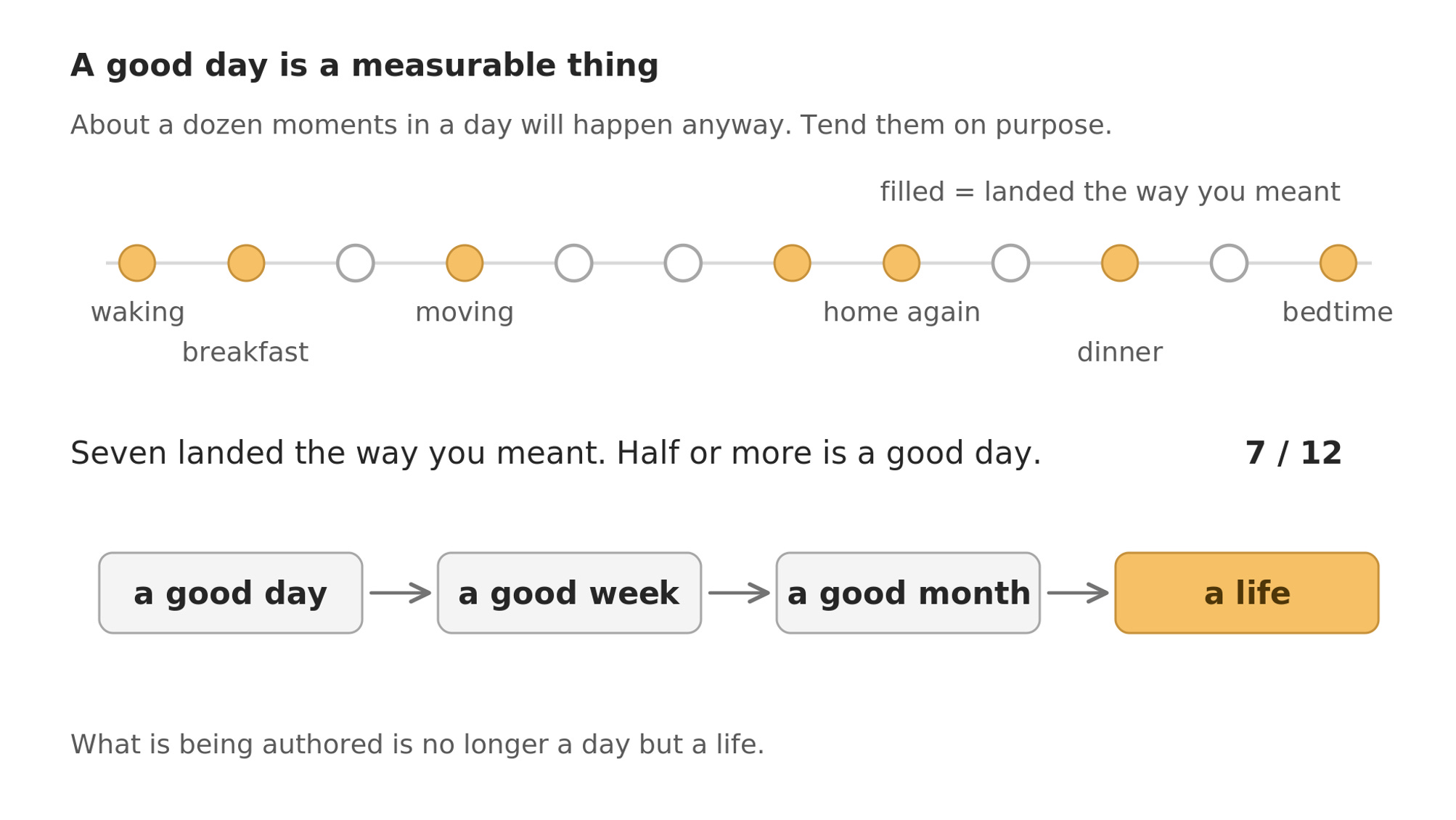
Daily-rhythm markers sit just below ritual and just above the body. On any given day, a dozen or so events will happen regardless: waking, the first meal, the first movement, the threshold between work and home, the evening meal, bedtime. The move is to take custodianship of those events rather than letting them happen by default. A good day, in this frame, is a measurable thing: half or more of those markers landing in roughly the shape one intended. Annie Dillard’s much-quoted line, that how we spend our days is how we spend our lives (Dillard, 1989), names the logic, and Csikszentmihalyi (1990) showed that the accumulation of well-attended episodes produces the felt sense of a meaningful life. Half is the threshold that matters. It is reachable from almost any starting point, and once a person holds it, the rest tends to compound: a good day repeats into a good week, a good week into a good month, until what is being authored is no longer a day but a life.
Sayings, proverbs, and inherited phrases are compressed wisdom that unpacks at the right moment. Mieder (2004), the foremost scholar of proverbs, defines a proverb as a short, memorable sentence that carries a people’s wisdom in fixed form and is handed down across generations. That is exactly why an inherited saying lands with an authority no purpose-built sentence can match. Coined phrases lack that inherited weight but accrue their own as they gather history within a particular collective.
Family or group shorthand is the private vocabulary that develops among people who have shared a collective for a while, what most members call its unspoken rules. The phrase carries the agreement; nothing more needs to be said once it is invoked. Polanyi (1966) named the structure tacit knowledge, knowing more than can be told; Edward T. Hall (1976) called it high-context communication, where most of an exchange’s meaning resides in the situation rather than the words. Outsiders find it inscrutable, which it is, until they are inside.
Jokes, songs, and meals work the same way, through repetition. A joke told fifty times becomes how a family marks a certain kind of moment; a song repeated at a certain kind of moment becomes that moment, the way “Happy Birthday” has fused so completely with cake and candles that a birthday feels unfinished without it; a standing Friday meal stops being food and becomes the marker of Fridays. Each is an ordinary thing that repetition has turned into a meaning-bearing artefact, and their seriousness is consistently underrated.
Named roles and protocols look propositional but work participatorily: they read like rules, but they live like practices, and the distinction matters. A name is not a category. A category drops a thing into a container, where it becomes interchangeable with everything else inside; a name does the opposite, holding the inexhaustibility of the particular: this person, this agreement, with its own history and weight. Once a group has named one of its practices, the name carries the whole logic and can be invoked in a word rather than re-argued each time. Brennan and Clark (1996) demonstrated the mechanism experimentally: as people work together, they form conceptual pacts, shared terms that thereafter carry an agreed meaning in a word or two. A team’s “no-meetings” day or a workplace’s “nine-day fortnight” does the same work, the name holding a whole arrangement steady so it need not be rebuilt whenever it is invoked. Where possible, name the thing; where necessary, categorise it; keep the two apart.
Refusals and absences are probably the most underrated tools here, and the oldest name for them is taboo. Strip the word of its superstitions, and what remains is a collective’s settled sense of what is simply not done. Mary Douglas (1966) showed taboo to be less about fear or hygiene than about order, a way of marking what belongs and what does not. What a storifier declines will shape the collective as surely as what they do, and the forms are easy to recognise once named: phones in a basket at dinner; the friend who lets a hard day pass without offering a fix; the parent who refuses to escalate when a teenager is venting and waits for the venting to run out. The contemplative traditions reached the same place by another road, calling it apophatic discernment, the clearing of what does not belong so the sense of right can recognise what does; the Sanskrit “neti neti” and the Christian “via negativa” are its theological versions. In an environment saturated with algorithmic content, refusal is among the storifier’s most protective acts: by choosing what to keep out of the collective’s attention, they make the quiet that meaning needs to gather. Storifiers who underrate refusal over-produce, crowding the collective with content it never asked for and breaking the generative flow already underway, the group’s version of the state that Sawyer (2007) found in jazz ensembles and improvising troupes, where authorship comes easily and confidently because the space is clear. That flow is what refusal exists to protect.
Improvised micro-scenes are the small, one-off moments that still enter the collective’s memory: a kitchen exchange in which something is said that did not need to be said, yet changes the shape of an evening, and a hand on a shoulder offered without comment. None will recur; all become part of what the collective is.
These tools form an ecology, each scaffolding the others so that dropping one weakens the rest. Rituals accrue their own shorthand; shorthand carries the jokes; the jokes remember the rituals; and the rituals are held in the meals and songs; the refusals keep the meals from being crowded out. A collective rich in rituals and thin on refusals is busy but shallow; one rich in shorthand yet cut off from the rhythms it grew from sounds private and feels hollow. The storifier’s work is partly knowing which tool a moment is asking for, usually without naming it, and partly knowing that no single practice survives without the others.
4.1 How the Inventory Fails
Every tool has a failure mode, and a craft described only in its healthy form implicitly claims it cannot be corrupted. It can. Rituals go rigid, kept as form long after the meaning has emptied out. Shorthand turns to gatekeeping, marking who is inside and who is out, often with cruelty. Inherited proverbs are deployed to shut down a fair complaint by dressing it in the authority of the ancestors. Refusal hardens into a punishing taboo. In a family, it is the silent treatment, the subject that can never be raised, the secret everyone is made to protect; at the wider scale, it is the old rule that shamed left-handed children into writing with a hand that was not theirs, a “purity” that protected nothing and cost much. In each, a collective’s healthy sense of what is not done becomes a fence around what cannot be said. Micro-scenes are staged for effect rather than offered, the distortion that Fromm (1955) called automaton conformity, where the apparently spontaneous gesture performs an expectation absorbed but never owned. And the over-producer saturates a collective with content nobody asked for, leaving members no room to author for themselves. The tools are not enough on their own; telling which one a moment is asking for, or asking to be set aside, is itself the craft, and it is the part most often missed by those who have read about authoring without having lived it.
5. The Same Work at Every Scale
The same work is done at each scale. The materials differ. The shape beneath them is one. The load-bearing claim is that iterative stewardship at any scale is, in fact, authoring: what looks like maintenance, feeding the body, holding a conversation, keeping the rituals, is narrative construction over time and a way of keeping a larger source connected to a life. The steward is always already an author, whether or not they recognise themselves as one.
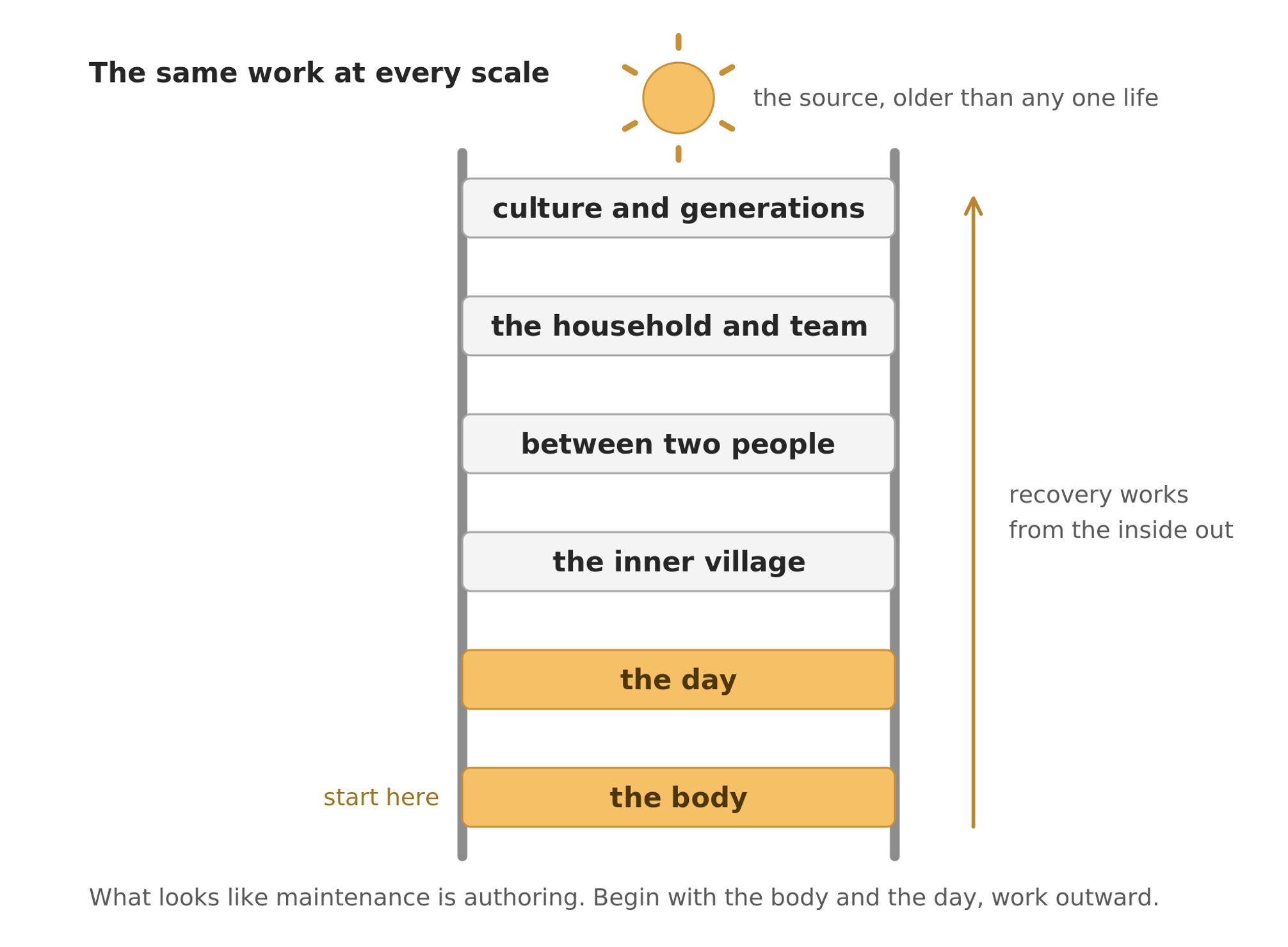
At the cellular scale, the body is its own collective. The trillions of cells, the systems they form, and the rhythms they sustain answer to no central executive; they are the foundation on which all the authoring above them becomes possible. The “Eat-Move-Rest” pattern, used throughout this series as a diagnostic and a daily anchor, is the custodianship of the stage before the play begins. The evidence is well established: Pollan (2008) on diet, Lieberman (2020) on movement, Walker (2017) on rest; and van der Kolk (2014) and Porges (2011) show that the body carries the history of its collectives in the nervous system, so that the cellular and the relational are one continuous architecture. A body fed, moved, and rested this way is the body from which a particular kind of author can emerge. The authoring here is in the steward’s orientation toward the cellular, not in the cells themselves.
At the daily-rhythm scale, the “Good Day” of the previous section becomes a rung of its own, the next step up from the cellular. Its logic is by now familiar: small, repeated days compound into a life (Csikszentmihalyi, 1990; Clear, 2018). Tend half of the dozen markers a day offers, and a good day becomes a good week and, in time, a good life. This is also where the deepest cultural authoring has taken place. The old religious traditions can be read as inherited “Good Day” templates, including the daily prayers of Islam, the Halakhah of Jewish life, the canonical hours of Orthodox Christian observance, and the daily forms of Buddhist practice, each an authoring project carried for centuries. Ann Taves (2009) describes religion, at one level, as the building of practices that let certain experiences be re-encountered rather than lost; a tradition is a memory device carried across generations for the shape of a good day and for staying connected to what it draws on. Modern secular life has thinned this rung, and much of today’s meaninglessness lives in that thinning.
At the interior scale, the “village of me’s” is the cognitive collective that requires stewardship. Internal voices, sub-personalities, conflicting impulses, and the residual presences of important others all take part in an interior story, facilitated by the “Master Me,” which works from within the outer collective and draws on friends, mentors, and the accumulated relational material of a life. The interior and exterior are recursive, each feeding the other. Authoring that fails here produces the experience of being inhabited by warring selves; authoring that works produces a coherent person who can hold multiplicity without being hijacked by any one part.
At the interpersonal scale, the move comes in two parts, and the research has names for both. The first in this series is called “mis-standing-under,” a play on misunderstanding, heard as mis-under-standing. The coinage takes the word literally: to under-stand a thing is to stand under it and find the place from which it makes sense. So when the meaning will not form, one assumes the gap is in one’s own way of standing, not in the other’s sense, and keeps shifting stance until the picture resolves, as a Magic Eye image, all noise until the eyes find the right focus, suddenly resolves into depth. The disposition has cousins the reader may know: the sensemaking community’s “Rule Omega,” which listens for the signal inside the noise; steelmanning (Dennett, 2013), which re-expresses another’s view so well they say “I wish I’d put it that way”; and Carl Rogers’s (1957) unconditional positive regard. At heart, it is a storifier’s gift, finding the larger story in what another is only half-saying and handing it back more whole than they could make it alone.
The second part, “fore-giving,” carries that charity forward in time. It extends the benefit of the doubt to what a person is still becoming, stepping into the reality they are reaching for and shoring up the parts not yet built. This is the Pygmalion effect (Rosenthal and Jacobson, 1968) put into practice: the regard we hold for someone helps draw out the reality, a way of witnessing what is yet to be until its author can realise it. A two-person collective built on both moves grows its own narrative substrate, strengthening a story and a person toward what they could fully become.
At the familial and small-group scale, the move is most familiar as the making and keeping of family culture, though the rung covers any sustained small group: the startup team, the friendship circle, the long-running working group. The tools of the previous section all apply here. Small groups that flourish have at least one, ideally several, members doing storifier work; those that come apart are usually the ones where the role went vacant or rested too long on a single pair of shoulders.
At the cultural and trans-generational scale, the move is the carrying forward of inherited forms, the proverbs, traditions, songs, names, and idioms a culture hands down between generations, and, more precisely, their adaptation to situations that did not exist when the form was coined. Preservation alone is not authoring: a proverb transmitted but never used in a new case calcifies into folklore. The storifier here renegotiates the inheritance with the present, the move Gadamer (1960) named the fusion of horizons, where an old form meets a current situation and both are changed by the meeting. This is the scale at which a person joins an authoring project that began before them and will outlast them; the authoring is in the adaptation, and it is how a living tradition stays a source rather than a relic.
The scales are bound by more than symmetry. The authoring move is a continuous practice across them, and capacity at one scale feeds the others: a person whose cellular story is in order has more bandwidth for the interpersonal and familial work, while a person in disarray at the cellular scale cannot author well at the family scale, however strong their concepts. You cannot pour from an empty cup, and the body that comes home depleted has little to give the household. This is why recovery works from the inside out, the ordering Stephen Covey (1989) called private victory before public: begin with the body and the day, let the interior come into some workable order, and only then reach through the interpersonal, familial, and cultural scales. People who try to repair the cultural scale before the cellular one usually fail; those who start nearest, with the life already at hand, usually arrive somewhere that holds.
One register remains to be named. What is at stake in authoring well across the scales is not only belonging but its felt depth: the registration, in the body and in the life, that one is inside something that matters and is helping it matter. The traditional name for this register is one a secular argument can still borrow: the sacred. The framework asks for no supernatural commitment, only the recognition that some configurations of participation are constitutive of a life worth living, and that this recognition is not metaphorical. When the storifier’s work is doing what it is for, it keeps open the conditions under which a collective can be felt as sacred in this secular sense, a life turned towards its source and warmed by it. Read back in this register, the diagnosis of Section 1 is that the modern world has thinned not only belonging but the sacredness of belonging; and the recovery is less a leap into something new than a turning back towards what was always available, the way someone long away finally turns up the road towards home. Earlier generations would have recognised the move without needing the vocabulary.
6. Anticipating Objections
A framework that travels widely will meet resistance, and a reader who has come this far is already carrying some of it. Meeting the strongest forms head-on is more useful than waiting to be ambushed by them. What follows addresses the main ones in compressed form, partly to answer them and partly to signal that the framework is held provisionally, not triumphantly.
First, that this is a soft anti-modern romanticism, a nostalgia for older orders, even for religion. It is not. The older orders were often coercive in ways the modern world has rightly dismantled, and the gains in personhood are retained. The point is narrower: the substrate of meaning was thinned by the very process that delivered those freedoms, and the recovery moves forward into participatory forms that hold the gains while restoring the substrate. Charles Taylor (2007), in A Secular Age, argues that the modern condition is repaired by composing new forms that take seriously what the old ones knew, not by retrieving the old forms wholesale; Hartmut Rosa (2019) describes the same forward-looking recovery as a resonance. Turning back towards a source, in this sense, reaches for something available now, the human need to participate in something larger, and it asks for no supernatural belief.
Second, that participation can fragment as much as it can hold. True, and Section 3.1 addresses this directly, with the fuller account of storifier malpractice in ERE III. The claim was only ever that participation is constitutive, not that it is automatically benign. The corrective is better participation, including participation in leaving a collective that has begun to feed on its members.
Third, that this subordinates the individual to the collective, dissolving the person into the group. It does the reverse. Section 2’s argument is that individual and collective meaning constitute each other, with neither reducible to the other; the individual remains real and the one who participates. A healthy collective, by the cult-versus-school line, leaves its members with more agency than it found, not less. The framework asks a person to connect to a larger source, not to vanish into it.
Fourth, that the framework is culturally particular. The diagnosis of an individual-meaning trap is most clearly a description of late-modern Western life. The constitutive picture of meaning, though, is close to the default in many non-Western traditions: the Southern African philosophy of Ubuntu, “I am because we are” (Mbiti, 1969; Ramose, 1999), and Buddhist accounts of anatta, the no-self, and dependent origination, things arising through one another. To that extent, the paper recovers what others have long held rather than inventing something new; the novelty, if any, lies in presenting the recovery in a register contemporary Western readers can receive.
Fifth, that it over-generalises about modernity. The modern arrangement varies, and any statement about it admits counter-examples. The claims are pitched at the level of structural pattern, not universal description; where a statement risks overstating, read it as naming a persistent tendency in particular registers of contemporary life, not a total historical verdict.
Sixth, that storification is an elite capacity, a rarefied one. It is neither, and that has been the point throughout. The role is widely distributed and usually unconscious; most people doing the work are unaware they are. Bruner’s (1990) finding that narrative is a basic mode of human cognition suggests the capacity is universal. This paper mostly aims to make the practice legible to itself, so that those who have been authoring all along can do it on purpose, and those who see it in others can support them.
7. Implications and Limitations
What this paper describes comes down to one move, required of any life that is going to hold together: to stop trying to make meaning alone and turn towards a source larger than oneself, taking up the storifier’s work of keeping the connection alive, within the collectives one already inhabits. The people who report empty lives are rarely short of values or beliefs; what they lack is a living participation in which meaning is made, by them, with others, over time. The recovery is to re-enter that stream and to see that even apparent solitude is a configuration of the collective, not its absence, so that no one is ever quite as cut off as isolation makes them feel.
The limitations should be stated honestly. This is a phenomenological, participatory proposal, not an empirical theory; its architectural claims await formal testing, and the conditions under which storification can be learned, trained, or carried across very different cultures are left for later work. Diagnostic protocols for clinicians and organisations are left to others, though the architecture suggests where they might be developed. The account of pathological storification here is brief, with the fuller treatment in ERE III. Several of the cross-disciplinary anchorings are gestured at rather than fully worked out; a thorough engagement with any one would be a paper in itself.
In register, this paper has done the technical work, naming concepts, distinguishing moves, and setting out a role. The companion essay series does the participatory half, meeting the reader in particular scenes from families, friendships, workplaces, and vocations; where this paper teaches, the essays accompany. ERE III takes up the inner architecture, Person, Ego, and Agent, on which all of this rests.
The framing is provisional: one way of reading a terrain that has room for several, with no claim to being the only or the best. But to the reader who began this paper carrying the hum of Section 1, the quiet “is this it?”, the answer it offers is not another belief to hold but a direction to turn: towards a source larger than yourself and towards the small, unglamorous work of keeping a shared world alive. The turn is available now, in the life already at hand. No argument can make it for you, and once made, it is never finished, because meaning is something tended, not something kept. That is not a conclusion so much as an open door. Take what resonates. Leave what doesn’t. 🤷
Glossary
Brief operational definitions of the technical terms used in this paper. Fuller treatment of several of these, particularly Person, Ego, Agent, and the village of me’s, appears in ERE III.
Apophatic discernment: The discipline of clearing what does not belong in a given moment, in service of the sense of right that recognises what does. Borrowed from negative theology (Christian via negativa; Sanskrit neti neti); in this paper it names the storifier’s tool of refusal, the small ongoing labour by which space is kept for what belongs to land.
Authoring move: The active, in-stream practice of sustaining a collective’s narrative and rhythm from inside that collective, using whichever participatory tools the moment is asking for. The authoring move is performed by storifiers, but the role is widely distributed and very often unconscious.
Collective meaning: Meaning understood as a property of participating wholes rather than of isolated selves. The paper distinguishes four overlapping senses: semantic meaning, existential meaning, narrative coherence, and participatory belonging.
Constitutive (as opposed to additive): Of meaning, the claim that collective participation is the material out of which individual selves are configured, not a supplement added to selves that pre-exist their collectives.
Fore-giving: The discipline of giving the person doing active work the conditions to succeed before they fail, rather than crowding them with critique. A named protocol, not a category of rule.
Good Day: Authoring at the daily-rhythm scale: a measurable composition of the ten to twelve recurring events of a day, with half or more landing in roughly the shape one intends.
Individual-meaning trap: The structural mismatch produced by attempting to generate existential meaning from inside a single self, without the participatory substrate that meaning requires.
Master Me: The most refined configuration of the interior collective, whose role is closer to a careful orchestrator than to a dictator of the village of me’s. Developed in detail in ERE III.
Mis-standing-under: The active discipline of standing under the other person’s words rather than over them; an interpersonal authoring move that holds space for the other’s articulation to grow rather than substituting one’s own explanation for it.
Narrative technology: Any of the participatory tools by which a collective’s narrative is sustained: rituals, daily-rhythm markers, sayings, shorthand, jokes, songs, meals, named protocols, refusals, and improvised micro-scenes.
Ecology of practices: The set of authoring practices (ritual, daily-rhythm, shorthand, fore-giving, refusal, and the rest) treated as mutually scaffolding rather than as a list. Dropping one weakens the others; cultivating one tends to cultivate the others.
Participation: Embodied, ongoing engagement in the shared life of a collective. In this framework, participation is the medium through which meaning becomes available, not an optional addition to a self that pre-exists its collectives.
Relevance realization: Borrowed from John Vervaeke and collaborators: the ongoing cognitive work of foregrounding what matters in a situation and backgrounding what does not. The storifier’s work, in this paper, is the management of relevance realization at the collective rather than the individual scale.
Sacred (secular sense): The felt depth of belonging when participation is well-conducted; the registration that one is inside something that matters and is participating in its mattering. Used here without commitment to supernatural theology, as the participatory register the framework is ultimately trying to sustain.
Sage: Canonical figure denoting one who has accumulated enough harmonious moments of participation to guide others through their own transformations. The storifier in any sustained collective is one configuration of the sage.
Scope of care: The territory a person has agreed, often implicitly, to look after; the specific arenas across which their stewardship and authoring work is being exercised.
Storifier: The author of a collective’s story; the member, or members, of any sustained collective who do the ongoing work of sustaining its narrative and rhythm. A function, not a rank.
Storifier malpractice: Patterns of misuse of the authoring role, including narrative monopolisation, dependency-production, symbolic foreclosure, and the use of shorthand or ritual to gatekeep or coerce. Developed in detail in ERE III.
Tonos: Optimal tension; right relation; the load-bearing register at which a system, scale, or practice holds together without becoming either slack or strained.
Village of me’s: The interior cognitive collective composed of sub-personalities, residual voices, conflicting impulses, and absorbed others, orchestrated by the Master Me. Heuristic rather than strictly metaphysical; overlaps with dialogical self theory, Internal Family Systems, and object-relations approaches. Developed in detail in ERE III.
References
Baumeister, R. F., & Leary, M. R. (1995). The need to belong: Desire for interpersonal attachments as a fundamental human motivation. Psychological Bulletin, 117(3), 497–529.
Baumeister, R. F., & Vohs, K. D. (2002). The pursuit of meaningfulness in life. In C. R. Snyder & S. J. Lopez (Eds.), Handbook of positive psychology (pp. 608–618). Oxford University Press.
Bell, C. (1992). Ritual theory, ritual practice. Oxford University Press.
Berger, P. L., & Luckmann, T. (1966). The social construction of reality: A treatise in the sociology of knowledge. Anchor Books.
Brennan, S. E., & Clark, H. H. (1996). Conceptual pacts and lexical choice in conversation. Journal of Experimental Psychology: Learning, Memory, and Cognition, 22(6), 1482–1493.
Bruner, J. (1990). Acts of meaning. Harvard University Press.
Clear, J. (2018). Atomic habits: An easy and proven way to build good habits and break bad ones. Avery.
Cloud, H., & Townsend, J. (1992). Boundaries: When to say yes, how to say no to take control of your life. Zondervan.
Covey, S. R. (1989). The seven habits of highly effective people. Free Press.
Csikszentmihalyi, M. (1990). Flow: The psychology of optimal experience. Harper & Row.
Dennett, D. C. (2013). Intuition pumps and other tools for thinking. W. W. Norton.
Dillard, A. (1989). The writing life. Harper & Row.
Douglas, M. (1966). Purity and danger: An analysis of concepts of pollution and taboo. Routledge & Kegan Paul.
Frankl, V. E. (1946/1985). Man’s search for meaning. Beacon Press.
Fromm, E. (1955). The sane society. Rinehart.
Gadamer, H.-G. (1960/2004). Truth and method (J. Weinsheimer & D. G. Marshall, Trans.). Continuum.
Garfinkel, H. (1967). Studies in ethnomethodology. Prentice-Hall.
Goffman, E. (1959). The presentation of self in everyday life. Doubleday Anchor.
Hall, E. T. (1976). Beyond culture. Anchor Books.
Hermans, H. J. M. (2001). The dialogical self: Toward a theory of personal and cultural positioning. Culture & Psychology, 7(3), 243–281.
Holt-Lunstad, J., Smith, T. B., Baker, M., Harris, T., & Stephenson, D. (2015). Loneliness and social isolation as risk factors for mortality: A meta-analytic review. Perspectives on Psychological Science, 10(2), 227–237.
Johnstone, K. (1979). Impro: Improvisation and the theatre. Methuen.
Lieberman, D. E. (2020). Exercised: Why something we never evolved to do is healthy and rewarding. Pantheon.
Lifton, R. J. (1961). Thought reform and the psychology of totalism: A study of brainwashing in China. W. W. Norton.
MacIntyre, A. (1981). After virtue: A study in moral theory. University of Notre Dame Press.
Mbiti, J. S. (1969). African religions and philosophy. Heinemann.
Mead, G. H. (1934). Mind, self, and society: From the standpoint of a social behaviorist. University of Chicago Press.
Mieder, W. (2004). Proverbs: A handbook. Greenwood Press.
OECD. (2023). Health at a glance 2023: OECD indicators. OECD Publishing.
Polanyi, M. (1966). The tacit dimension. Routledge & Kegan Paul.
Pollan, M. (2008). In defense of food: An eater’s manifesto. Penguin.
Porges, S. W. (2011). The polyvagal theory: Neurophysiological foundations of emotions, attachment, communication, and self-regulation. W. W. Norton.
Putnam, R. D. (2000). Bowling alone: The collapse and revival of American community. Simon & Schuster.
Ramose, M. B. (1999). African philosophy through Ubuntu. Mond Books.
Rappaport, R. A. (1999). Ritual and religion in the making of humanity. Cambridge University Press.
Ricoeur, P. (1984–1988). Time and narrative (Vols. 1–3). University of Chicago Press.
Rogers, C. R. (1957). The necessary and sufficient conditions of therapeutic personality change. Journal of Consulting Psychology, 21(2), 95–103.
Rosa, H. (2019). Resonance: A sociology of our relationship to the world. Polity.
Rosenthal, R., & Jacobson, L. (1968). Pygmalion in the classroom: Teacher expectation and pupils’ intellectual development. Holt, Rinehart & Winston.
Sawyer, R. K. (2007). Group genius: The creative power of collaboration. Basic Books.
Schwartz, R. C. (1995). Internal family systems therapy. Guilford Press.
Spolin, V. (1963). Improvisation for the theater: A handbook of teaching and directing techniques. Northwestern University Press.
Strawson, G. (2004). Against narrativity. Ratio, 17(4), 428–452.
Taves, A. (2009). Religious experience reconsidered: A building-block approach to the study of religion and other special things. Princeton University Press.
Taylor, C. (1989). Sources of the self: The making of the modern identity. Harvard University Press.
Taylor, C. (2007). A secular age. Belknap Press of Harvard University Press.
Twenge, J. M. (2017). iGen: Why today’s super-connected kids are growing up less rebellious, more tolerant, less happy, and completely unprepared for adulthood. Atria Books.
Vaillant, G. E. (2012). Triumphs of experience: The men of the Harvard Grant Study. Belknap Press of Harvard University Press.
Van der Kolk, B. A. (2014). The body keeps the score: Brain, mind, and body in the healing of trauma. Viking.
Vervaeke, J., Lillicrap, T. P., & Richards, B. A. (2012). Relevance realization and the emerging framework in cognitive science. Journal of Logic and Computation, 22(1), 79–99.
Vygotsky, L. S. (1978). Mind in society: The development of higher psychological processes. Harvard University Press.
Walker, M. (2017). Why we sleep: Unlocking the power of sleep and dreams. Scribner.
Further Reading
Wider conversation. On meaning crisis and participatory cognition: Vervaeke’s Awakening from the Meaning Crisis, with Charles Taylor and James K. A. Smith for genealogical context. On developmental and object-relational accounts of the participating self: Daniel Stern, the Boston Change Process Study Group, and Donald Winnicott. On the divided attention modern culture has structurally favoured: Iain McGilchrist’s The Master and His Emissary and The Matter with Things. On sensemaking and the practice of Rule Omega: Daniel Schmachtenberger and Jordan Hall, in the Rebel Wisdom conversations.
