

I was scrolling through a WhatsApp group when I saw the video. A man was walking through his house, room by room, filming the destruction: shattered glass, overturned furniture, holes punched in walls. His voice kept repeating: “Look at this. Look at this.”

The caption said a 12-year-old had done it, that the parents had confiscated their phone and the child had responded by destroying the house. The question posed to our group was simple: “What would you do if your child did this?”
I stared at the video for a long time, and then I felt it, that pit in my gut. Not anger at the child, and not shock at the destruction, but something else entirely.
I realised that if this happened in my home, it would mean I’d already failed. Not in that moment, but long before, in a hundred small moments I’d let slip by. Because a child doesn’t smash a house over a confiscated phone. A child smashes a house because the ledger has been filling for years, and this was the final entry that triggered the bankruptcy. The straw that broke the camel’s back.
Two Ledgers
In Article 3, we talked about how the body keeps accounts, how it tracks every transaction (sleep, food, stress, rest) and eventually balances the books.
But that morning, looking at the smashed house, I realised something I hadn’t seen before. The body doesn’t only track resources; it also tracks unresolved conflicts, and it stores them as trauma. Every snide comment left unexplored, every tension swept under the rug, every moment of disconnection ignored because “it’s not a big deal.” The body remembers all of it.
And like energy debt, there’s a lag time. You can ignore the small conflicts for days, weeks, even years, and you feel fine the whole time. The house feels stable, until it’s not. Until someone wakes up on the floor, or zigzags across a path, or smashes every room in the house.
The Evil of the Day
There’s a Bible verse that’s been rattling around in my head lately: “Sufficient unto the day is the evil thereof.”
Matthew 6:34. It’s a strange and pessimistic line because it assumes every day has evil. Not might, not could, but has.
I used to think it meant: “Don’t worry about tomorrow’s problems, because today’s are enough.” But now I think it means something deeper than that.
Each day comes with its own conflicts, its own tensions, its own small betrayals and disconnections, and we’re actually equipped to resolve them within that day. The problem is that we don’t. We let them slip, we tell ourselves it’s not worth the fight, we avoid the hard conversation, and we smooth it over with a joke or a distraction.
And the body (yours, theirs, the collective body of the family) adds it to the ledger, day by day, line by line, until the ledger is so full that a confiscated phone becomes the match that burns the house down.
The Hungry Self
I’ve learned to recognise a specific state in my children, and in myself, that I call “temporary possession.” It happens when someone gets hijacked by a biological need they’re not aware of: the hungry self, the tired self, the anxious self.
When Serena gets hungry, she changes. Her negativity increases, her pessimism spikes, and she becomes short-tempered and fragile. She’s not trying to be difficult; she’s been commandeered by her blood sugar. The version of her standing in front of me isn’t the full person but a temporary possession.
If I don’t recognise this, if I treat her behaviour as who she is rather than a state she’s in, I’ll respond to her harshly and add another line to the ledger, another unresolved conflict. But if I can see it, if I can recognise the temporary possession, I can fore-give her.
Not forgive, after the fact, but fore-give, which means to give her what she needs before the conflict escalates. I get her food, I wait for her blood sugar to rise, and I afford her extra kindness and patience until the real version of her returns. And when she’s back, she has the bandwidth to think clearly, to be kind, and to connect.
The Steward’s work isn’t only managing your own body. It’s also recognising when the people you love are being piloted by their biology and helping them get the Steward back in the driver’s seat before the crash happens.
The Pasta That Wasn’t
A few weeks ago, I made spaghetti bolognese for dinner. I’d planned it carefully and even suggested we go to the store and pick out a fun pasta shape together, but the children weren’t interested, so we used what we had at home.
I served it proudly, and Serena took one bite and said: “I don’t want this.”
My heart sank. All that effort, all that care, rejected in a single sentence. For a moment, I felt the old reflex rising, the urge to take it personally and say: “This is what we’re having and you are going to eat it! Or else....”
But I caught it. I realised that the goal isn’t for her to eat what I made. The goal is for her to eat something that nourishes her. So instead, I asked: “What would you rather have?”
She went and browsed the pantry and came back with two-minute noodles. I swallowed my disappointment, put her plate of pasta back in the pot. I started to make the noodles and I noticed we could make them together, so I invited her to come and make the noodles with me, and she did. She was delighted and ate 80% of the bowl.
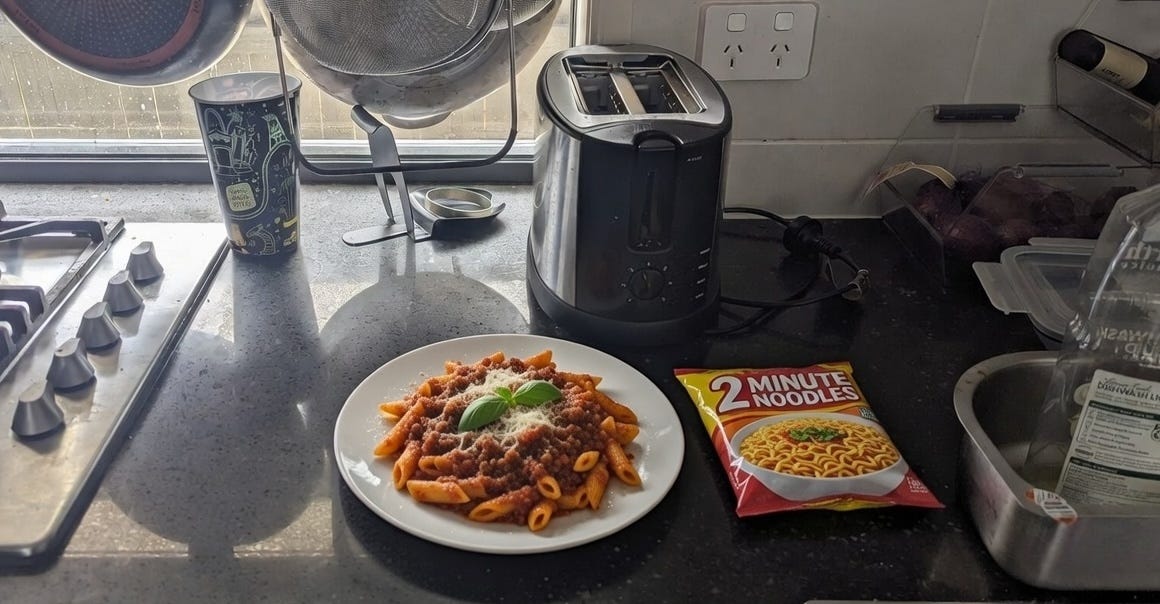
Later, I reflected on what had happened. I’d fore-given her by adjusting to the new reality without resentment. I’d prioritised her need over my plan, and in doing so, I’d avoided adding another line to the ledger, another moment of disconnection, another small conflict that would compound over time.
The Driver’s Choice
Phiona and I have a rule in our family called “Driver’s Choice,” and it came about after a near-crash.
One weekend, we were driving to Bribie Island, and Phiona kept giving me instructions: slow down, turn here, watch out for that car. At one point, as I was exiting a roundabout, I almost crashed because I was trying to listen to her and drive at the same time.
We had an argument, and in the middle of it, I realised we needed a rule for this. So we created one: when someone is driving, they’re in charge. They choose the music, they choose the route, they choose the speed within reason and as dictated by the speed limit. The passengers can offer help, but only when asked.
The purpose was to protect the driver from distractions, because if the driver is distracted, we’re all at risk. Everyone loved it, and it worked.
And then we realised that this principle applies to more than driving. It’s about fore-giving the person in the active role, giving them what they need to succeed before they crash. It’s about recognising who’s piloting at any given moment and clearing the static so they can tune in.
The Smashed House Revisited
So what would I do if my child smashed the house?
I would recognise it as evidence of a deep meaning crisis, not only in the child, but in all of us who live together. I would know that we’d lost our connection on multiple levels, that the ledger had been filling for years, and that we’d stopped resolving the daily conflicts and let them compound until the system collapsed.
And I would get to work putting my home in order. Not by punishing the child, and not by focusing on the broken furniture, but by asking: what unresolved conflicts have we been carrying, what small betrayals have we ignored, and what daily evils have we failed to address?
Because the body keeps two ledgers. One tracks energy: sleep, food, hydration, rest. The other tracks connection: conflicts resolved, tensions acknowledged, moments of presence, acts of fore-giving.
And like energy, you can run a deficit for a while and borrow from tomorrow to survive today, but biology always balances the books.
The only question is whether you want to pay the bill on your terms, with small daily deposits, or whether you want the body to force a correction, waking you up on the floor, zigzagging you off the path, or smashing every room in the house.
The Steward’s Log
I still get caught up in conflicts, and I still let tensions slip by. I’m not perfect at this.
But I’ve learned to recognise the pit in my gut, that feeling that tells me a line was added to the ledger, and when I feel it, I have a choice.
I can let it slide, tell myself it’s not a big deal, and wait until it compounds. Or I can stop, turn around, and address it now while it’s still small.
“Hey, that comment you made, it landed funny. Can we talk about it?”
“I know you’re frustrated. Let’s figure this out before it gets bigger.”
“You seem off. Are you hungry, tired? What do you need right now?”
These conversations are awkward and inconvenient, and they take time and energy I don’t always have, but they’re the deposits that keep the ledger solvent. They’re the daily practice of stewardship, not only of my own body, but of the collective body we call a family.
Sufficient unto the day is the evil thereof. Each day has enough trouble, enough small conflicts, and enough opportunities for disconnection. But each day also has enough capacity, enough grace, enough patience, enough kindness, to resolve what arises, if we do the work, if we make the deposits, and if we fore-give before the ledger forces us to pay.
Questions for the Steward
The Ledger: What unresolved conflict are you carrying right now, and what small tension have you told yourself is “not a big deal”?
Temporary Possession: Who in your life is currently being piloted by their biology (hunger, fatigue, anxiety) and can you see the temporary possession, or are you treating the behaviour as who they are?
The Daily Deposit: What is one small conflict you can resolve today, before it compounds, and what conversation can you have now instead of waiting for the crash?
