

I wish I could say I was drunk.
I wish I could say I was exhausted, or that it had been a terrible day at work, or that something traumatic had happened. But it wasn’t any of those things.
It was a regular Tuesday evening. We were about to have dinner. Grilled chicken on the table, the smell filling the room. My son, Delvin, was two and a half years old, doing what toddlers do, running around the table, playing a pretend game about the Go Jetters trying to chase down Grandmaster Glitch, holding his Glitch toy high above his head and singing the theme song as he went.
In his excitement, he bumped the table as he passed. A glass tipped and started to roll, slow, across the tabletop towards the edge.
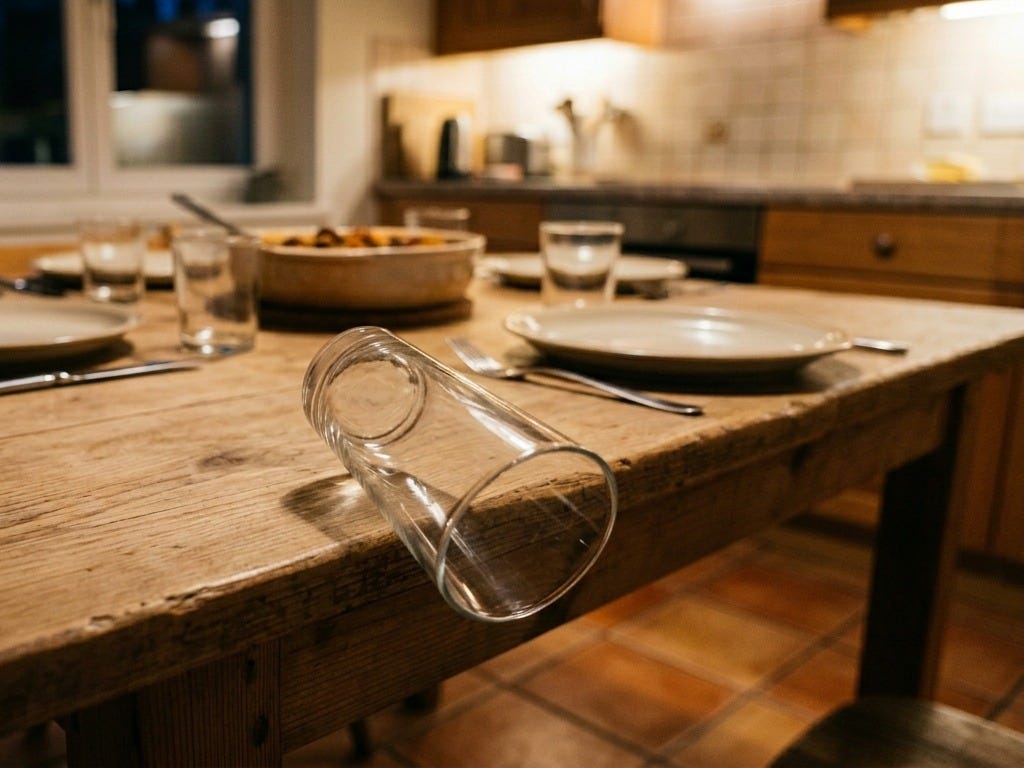
Delvin didn’t see it. He was still singing, still chasing, rounding my chair, his small body brushing past me. I remember wanting him to stop. Not out of anger. I didn’t have enough left in me for anger. I wanted quiet. I wanted the evening to proceed the way evenings were supposed to proceed: food, bath, bed. I wanted one part of the day to go smoothly.
And my hand, my sweaty hand, dropped the phone on the table and swung out and slapped him across the face. It happened so fast that the sound arrived before I understood what I had done.
He fell to the floor. He wasn’t crying yet. He was staring up at me from the tiles with his eyes wide and his mouth open, fixed on my face like he was seeing me for the first time. In his world, when things fall down they get back up and there is always a song for it. But he wasn’t getting up. He seemed to be wondering what had happened and who this person was, sitting above him at the table.
And in that frozen moment, I looked at my hand. I looked at my son on the floor.
And I thought: Who did that?
Because it didn’t feel like me. But it was me.
The Collapse
I dove off my chair. My knees hit the cold tiles and I pulled him to my chest, but he was stiff, stiff the way a child gets when the arms around him don’t feel right, when the body holding him is the same body that hurt him. It is one thing to hurt someone. It is another to feel, in their body, that they no longer trust yours.
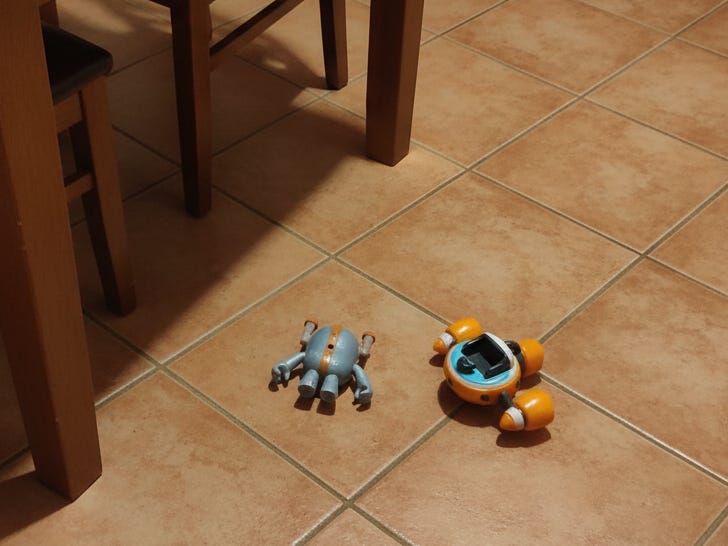
I held him against my chest, rocking him, apologising over and over while my heart hammered against my ribs. He was still stiff. The chicken was going cold on the table. Glitch was face down on the floor.
Phiona hadn’t moved. She was still in her chair, her hands flat on the table, watching me the way you watch someone you are no longer sure you know. She didn’t say anything. She didn’t need to. Her stillness was the stillness of someone looking at a person they love and suddenly wondering what else is there.
After everyone was asleep that night, I sat in the dark and stared at the wall. The house was quiet in that way houses go quiet after children fall asleep, where the floorboards settle into themselves and the fridge hums like a witness trying not to intrude.
Phiona and I didn’t talk about it that night. We didn’t talk about it for days. We moved around each other the way you move around furniture in a dark room, carefully, aware of the edges. She didn’t accuse me of anything. She didn’t have to. The way she handed me things without meeting my eyes said more than any argument could have.
How did that happen? I wasn’t a violent man. I loved my son. So where did that violence come from?
The Pretend Game
To understand that moment, you have to understand the man sitting at that table.
On paper, I was winning. We had moved to Australia. We were earning more money than we’d ever had before, living in the nicest place we had ever lived, and as a provider, I had achieved far more for my family compared to how life was before we left Uganda. In my head, these were the ingredients we needed for building a good life.
But the experience of what we had was not what I would call good.
I felt lonely while sitting with my loved ones. It was a kind of loneliness I didn’t have a name for at the time, a feeling that I was participating in a pretend game that had been set up by the circumstances of living together. I would come home and sit at the table and smell the food and still not really be there. My eyes were down, my thumb was scrolling, and whatever Phiona was saying was happening on the other side of a wall I didn’t know I’d built.
Some close friends of mine were starting to entertain the idea of divorce around that time, and it sounded plausible to me. That’s how far gone I was. I thought the solution might be to leave, when I hadn’t even tried to show up.
Dinner wasn’t a meal with my family; it was a task between “arrive home” and “put children to bed.”
I was so efficient at managing my life that I had forgotten how to participate in it.
The Empty Ledger
And underneath the meaninglessness, there was something physical.
I hadn’t slept well in weeks. I was stressed about work. I was eating poorly. I was ignoring every signal my body was sending, the tight chest, the short temper, the exhaustion that sat behind my eyes like a headache that never quite arrives.
The body had been warning me for weeks: you’re overdrawn, you need to stop, you need to rest. But I ignored it. I pushed through. I told myself I was fine.
And when the ledger finally ran out, when there was nothing left in reserve, the deficit collected itself all at once. It collected through my hand, onto the face of a two-and-a-half-year-old boy whose only crime was being playful near a glass of water.
That is still difficult for me to write.
Logicising vs. Resonating
In my journals from that time, I started writing about the difference between logicising and resonating.
For five years, I had assumed that Phiona was a terrible communicator. I believed that if she articulated things the way I did, what she was saying would become obvious to me. So when she talked and it didn’t make sense to me, I would discard what she said and charge it to her poor communication. Sometimes I made fun of her for it. When she told me, over and over, that I wasn’t listening, I heard it as further evidence that she didn’t know how to say what she meant.
It took a friend named Rose, using careful questions over coffee one afternoon, to show me that Phiona wasn’t wrong. I was missing something. I was listening for what made sense to me instead of listening for what she meant. I was debugging her, the way you debug code. And I was doing the same with the children. When Delvin cried, I didn’t wonder what he was feeling; I wondered what would make him stop.
The slap happened because I had zero resonance. I was so trapped inside my own stress and my own empty ledger that I couldn’t feel the reality of the small boy in front of me. He was right there, singing and alive, and I could not feel him at all.
Updating Your Version
To love someone, you have to be willing to update your version of yourself.
That night, the old version of Clayton died.
The version that had mistaken providing for caring. The version that had mistaken managing for loving. The version that had mistaken staying busy for showing up.
I realised that if I didn’t change, fundamentally change, I would destroy the very people I was working so hard to provide for.
I earned the right to quit that night.
I quit being the Pilot. And I began the long, messy, imperfect process of becoming a Steward.
The Origin of the Framework
People sometimes ask me why I write about stewardship. Why I track ledgers, why I build rules and rituals, why I treat the body like something that needs to be listened to instead of managed.
It’s not because I’m smart. It’s not because I read a lot of philosophy.
It’s because I’m scared.
I am scared of the man who slapped his son. I know he’s still in there. I know that if I get tired enough, stressed enough, disconnected enough, the version of me that treated his family like a program to be managed will try to take the wheel again.
I practise stewardship because I never want to see that look on my son’s face again. That look where the world was supposed to make sense and suddenly it didn’t.
The Steward’s Log
Delvin is older now. He doesn’t remember that night.
The other day he walked into the kitchen and said, “Dad, I think I need a snack. My tummy feels weird and I’m getting grumpy.” He said it the way you’d say it’s raining outside, casual and certain, a boy who has learned to read his own body and report what he finds there. I turned away for a moment because I didn’t want him to see what that sentence did to me.
We have rituals and rules and a language of experience we’ve built together.
But I remember.
I keep the memory of that Tuesday evening close. Not as punishment, but as a reminder that love is not measured only by what I intend or what I provide, but by what the people around me are actually made to live through. Because when I lose capacity, when I run my ledger empty, I don’t become tired or grumpy. I become someone I don’t recognise. Someone who can look at a singing child and see only noise. Someone who can respond to an accident with violence.
Not because I’m good at it, but because I know what happens when I stop.
Questions for the Steward
The Empty Ledger: When have you hurt someone, with words or actions, not because you’re a bad person, but because you were running on empty? What was your body trying to tell you that you ignored?
The Pilot: Where in your life are you treating people like inefficiencies to be managed rather than humans to be felt?
The Capacity Check: Look at your reserves right now. If someone spilled something on you today, would you have the margin to laugh it off, and if not, what deposit do you need to make before the day gets harder?

This was a powerful piece, Clayton. Thank you for what you wrote here. It is very important.
I have finally found language for some of the feelings I have. Thank you for this piece Clayton.